
Customers want to know when their order will arrive before completing a purchase. However, not every store needs the same delivery experience. Some customers only need an expected arrival date. Others need to choose the exact day or time when the order will reach them.
A Shopify delivery date picker lets customers select an available delivery or pickup date from a calendar. A Shopify estimated delivery date shows when an order is likely to arrive, but it does not let the customer choose the date.
The right option depends on what you sell and how you fulfil orders. In this guide, I will explain the difference, when each option works best and how stores offering Shopify local delivery can use both without making the buying process confusing.
What Is a Shopify Delivery Date Picker?
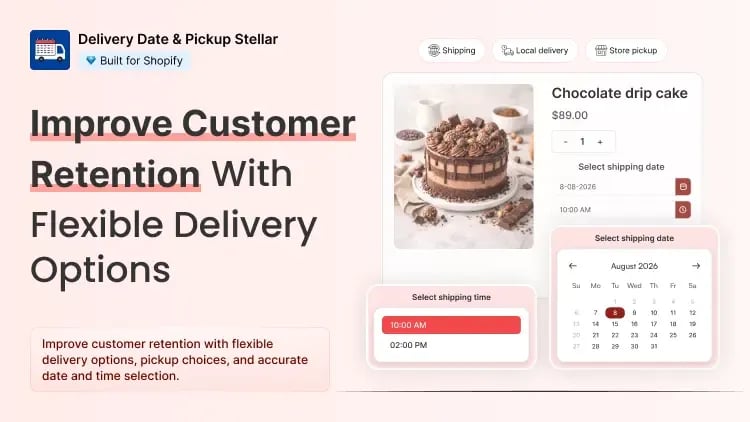
A Shopify delivery date picker is a calendar that appears on the product page, cart, cart drawer or checkout. It lets customers choose a delivery, shipping or pickup date from the options made available by the merchant.
Some apps also let customers select a time slot. This feature is useful when the order is connected to a specific event or when the customer must be available to receive it.
A Shopify delivery date picker can also help merchants control their workload through settings such as:
- Minimum preparation time
- Same-day delivery cutoffs
- Available weekdays
- Holiday and blackout dates
- Delivery and pickup time slots
- Order limits for each slot
- Product-specific delivery rules
- Location-based availability
What Is a Shopify Estimated Delivery Date?
A Shopify estimated delivery date tells customers when an order is expected to arrive.
It may appear as:
- Estimated delivery: August 12
- Arrives between August 12 and August 14
- Order today for delivery by Friday
- Delivery in three to five business days
The customer does not select the date. The estimate is calculated using information such as processing time, transit time, shipping method, destination, business days and order cutoff time.
Which Option Gives Customers More Control?
A Shopify delivery date picker gives customers more control because they can select from the dates or time slots your store makes available. A Shopify estimated delivery date gives customers useful information, but it does not reserve a date. It is a prediction or delivery promise based on your fulfilment and shipping settings. Consider a flower order for an anniversary.
An estimated arrival between Monday and Wednesday may be too uncertain. The customer needs the flowers on Tuesday. A picker lets them select Tuesday, while your store decides whether that day is still available.
For a standard T-shirt order, the exact day may not matter. Showing “Arrives by Tuesday” may provide enough confidence without adding another choice to the buying journey.
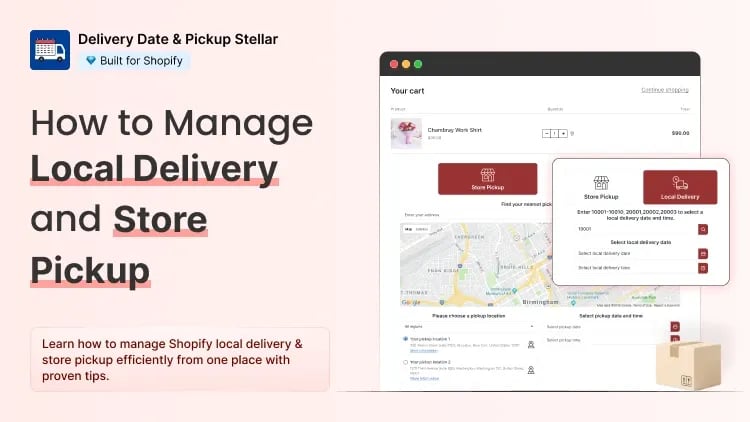
When a store offers shipping, pickup and Shopify local delivery, using separate tools for every delivery method can create more work.
This is where Delivery Date & Pickup Stellar can fit naturally into the fulfilment process.
Stellar adds a Shopify delivery date picker and time slots to the product or cart page. Customers can schedule local delivery, in-store pickup or shipping based on the options you provide. Shopify Plus merchants can also display the delivery calendar at checkout.
The app can also show an estimated delivery date and time. This means a merchant can offer scheduling where customers need control and display an estimate where customers only need information.
When Should You Use a Delivery Date Picker?
Use a Shopify delivery date picker when the delivery day is an important part of the order.
Bakeries and Cake Stores
Cakes and baked goods are often purchased for birthdays, weddings and events. Delivering too early or too late can make the order less useful. A picker lets customers choose the event date while the bakery controls preparation time, closed days and daily order capacity.
Florists
Flowers are commonly ordered for anniversaries, celebrations, funerals and holidays. Customers often need delivery on a specific day.
A date picker can help a florist offer same-day and scheduled Shopify local delivery while closing full slots and blocking unavailable dates.
Grocery and Meal-Delivery Stores
Fresh food requires careful timing. A customer may prefer a morning, afternoon or evening window rather than an all-day estimate.
A Shopify delivery date picker with time slots helps the merchant balance kitchen capacity, staff availability and delivery routes.
Gift Stores
A gift may need to arrive on a birthday, anniversary or festival date. Letting customers choose the date provides more certainty than showing a broad delivery range.
Furniture and Appliance Stores
Large items may require the customer to be at home. Scheduled delivery dates and appointment windows are more practical than a general estimate.
Store Pickup Businesses
Customers using click and collect may want to choose when they will visit the store.
Pickup slots give staff enough time to prepare the order and can prevent too many customers from arriving at the same time.
When Is an Estimated Delivery Date Enough?
A Shopify estimated delivery date is often enough when the order is shipped as a standard parcel and the customer does not need to choose a specific day. This may apply to stores selling:
- Clothing
- Books
- Phone accessories
- Beauty products
- Home accessories
- General non-perishable items
For these products, most customers want a clear answer to one question:
When should I expect the package?
An accurate date or date range can answer that question without adding another field to the cart.
An estimate is also useful when the shipping carrier controls the delivery schedule. Your store can communicate the expected arrival, but it cannot promise that a customer-selected time slot will be available.